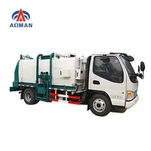


As key transportation vehicles in the oil supply chain connecting production and consumption ends, road tanker trucks have capacity specifications that directly determine transportation efficiency and suitability for application scenarios. Starting from core capacity specifications, this article will further analyze key knowledge points such as capacity classification, influencing factors, safety regulations, and industry development trends, helping readers gain a comprehensive understanding of the characteristics of the road tanker truck industry.
I. Core Knowledge Point: Capacity Specification Range of Road Tanker Trucks
There is no unified standard for the capacity of road tanker trucks; it needs to be flexibly configured according to transportation requirements, chassis load-bearing capacity, and regulatory restrictions. Common specifications are measured in liters (L), covering all scenarios from small-scale distribution to large-scale transportation. The core capacity ranges and corresponding scenarios are as follows:
1. Small-Scale Tanker Trucks (2,000L – 10,000L)
This range is the main specification for short-distance and small-batch deliveries. Among them, 5,000L, 6,000L, and 10,000L are the most common sub-models. These vehicles usually adopt light-duty truck chassis (such as Dongfeng Furika, Foton Ollin, etc.), featuring flexible bodies that can easily navigate narrow roads or internal roads of construction sites. They are mainly used in scenarios such as refueling for local small gas stations, temporary refueling for construction machinery at construction sites, and distribution to scattered oil supply points in remote areas. For example, 5,000L tankers are often equipped with Dongfeng Dolika chassis, matched with Yuchai 140-horsepower or Chaochai 130-horsepower engines, and equipped with power steering and air brakes, making them suitable for short-distance, high-frequency, and small-capacity delivery needs.
2. Medium-Scale Tanker Trucks (12,000L – 25,000L)
Tank capacities in this range are 12,000L to 25,000L, corresponding to fuel loads of 10 to 22 tons. For this reason, medium and heavy-duty truck chassis (such as Dongfeng 153, Dongfeng Tianjin, etc.) must be selected to ensure stable load-bearing. These vehicles balance transportation efficiency and passage flexibility, serving as the core force for regional oil distribution. They can achieve centralized delivery to multiple small oil supply points or regular replenishment for medium-sized gas stations. Among them, 15,000L tankers, with their balanced capacity advantage, can effectively reduce transportation frequency and improve regional distribution efficiency; 20,000L – 25,000L models are suitable for batch replenishment at large gas stations or short-distance inter-regional oil transfer.
3. Large-Scale Tanker Trucks (30,000L and Above)
The minimum capacity in this category is 30,000L. For higher specifications, the capacity of semi-trailer tankers can reach 40,000L – 51,000L (approximately 40 – 51 cubic meters), corresponding to an oil loading capacity of over 28 tons. Such vehicles require heavy-duty truck chassis or trailer semi-trailers (such as Dongfeng Tianlong, FAW Jiefang J6, etc.). Specifically designed for long-distance and large-scale oil transportation, these vehicles minimize unit transportation costs to the greatest extent and serve as the core carriers for national inter-regional oil allocation. In some compliant regions, specially designed road trains (such as four-trailer tankers in Australia) can have a capacity exceeding 120,000L. However, due to domestic road regulations, the mainstream capacity of large-scale tankers in China remains 30,000L – 51,000L.
II. Key Factors Affecting the Capacity of Road Tanker Trucks
The capacity of tanker trucks is not arbitrarily determined; it needs to take into account multiple factors to ensure transportation safety and compliance:
1. Chassis Load-Bearing Capacity
The chassis serves as the foundation for the load-bearing capacity of a tanker truck. The rated load capacity of different types of chassis directly determines the maximum tank capacity. Light-duty truck chassis have lower rated load capacity, corresponding to small-scale tankers; medium and heavy-duty trucks as well as semi-trailer chassis have higher rated load capacity, which can be matched with medium and large-scale tanks. For example, the "front four and rear eight" chassis can carry a capacity of 26 – 36 cubic meters, while semi-trailer chassis can support large-capacity tanks of over 40 cubic meters.
2. Road Regulatory Restrictions
Each country and region has specific regulations on the total weight and axle load of road vehicles, which directly limit the maximum capacity of tanker trucks. In China, there are strict controls on the size and weight of dangerous goods transport vehicles to prevent excessive vehicle weight from affecting road traffic safety. Therefore, the capacity of large-scale tankers must be designed within the allowable total weight range specified by regulations.
3. Characteristics of Transported Oil Products
Different types of oil products have different densities; under the same volume, the loading mass varies, which indirectly affects capacity selection. For example, the density of gasoline is approximately 0.75 g/cm³, while that of diesel is approximately 0.85 g/cm³. When loading the same mass of gasoline and diesel, a larger tank volume is required for gasoline. In addition, when transporting special media such as corrosive chemicals or liquefied gases, the tank needs to be equipped with anti-corrosion linings or pressure devices, which occupy part of the internal space and reduce the actual effective capacity.
4. Safety Design Requirements
Tanker bodies must be equipped with safety components such as anti-vibration plates and static elimination devices. To prevent oil sloshing from causing vehicle rollover, the actual loading capacity of the tank is usually no more than 95% of the rated volume, with a certain safety margin reserved. Although these safety designs do not directly determine the maximum capacity, they affect actual transportation efficiency.
III. Industry Safety Standards Related to Tanker Capacity
As vehicles for transporting dangerous goods, the design and use of tanker trucks must strictly comply with industry safety standards:
- Capacity Marking Specifications: The tank body must clearly indicate rated capacity, permitted loading medium, maximum loading weight, etc. Overloading is strictly prohibited, as it may cause tank rupture, oil leakage, or other safety accidents.
- Material and Structural Requirements: The tank body should be made of high-quality low-carbon steel or aluminum alloy. Aluminum alloy is widely used in fuel transport tankers due to its light weight and low spark risk, enabling vehicles to increase effective loading capacity while ensuring safety.
- Electrostatic Protection: Regardless of tank size, tanker trucks must be equipped with electrostatic dissipation devices (such as grounding wires, conductive materials, etc.) to prevent static accumulation caused by oil flow friction from triggering fires or explosions. Due to their larger loading capacity, large-capacity tankers have more stringent electrostatic protection requirements.
- Regular Inspections: Tank bodies must undergo regular pressure resistance and tightness tests to ensure no damage or leakage risks. For large-capacity tanks, inspection frequency and standards are even higher to ensure the safety of long-distance transportation.
IV. Impact of Industry Development Trends on Tanker Capacity
With the advancement of industry technology and increasingly strict environmental protection requirements, tanker capacity design has shown new trends:
1. Lightweight Design Enhances Effective Capacity
By using lightweight materials such as aluminum alloy tanks and high-strength steel, the weight of the tank is reduced without changing the chassis' load-bearing capacity, thereby increasing effective loading capacity. This enables "lightweight vehicles to carry heavy loads", improving transportation efficiency while reducing fuel consumption.
2. Intelligent Configuration Optimizes Capacity Utilization
New-generation tanker trucks are generally equipped with intelligent devices such as liquid level sensors and GPS tracking systems. These devices can real-time monitor tank remaining capacity, accurately plan delivery routes and loading quantities, and avoid low transportation efficiency or overloading risks caused by capacity estimation errors.
3. New Energy Transition Adapts to Specific Capacity Scenarios
With the application of new energy technologies such as electric power and hydrogen fuel, tanker trucks are gradually transitioning to clean energy. Currently, new energy tankers mainly focus on small and medium-sized capacity scenarios below 20,000L, suitable for short-distance urban delivery. In the future, with battery technology upgrades, they are expected to gradually cover larger capacity transportation needs.
V. Summary
The capacity range of road tanker trucks spans from 2,000L to over 51,000L. Different capacity specifications correspond to various transportation scenarios and chassis configurations, forming an industry pattern of "small-scale distribution, medium-scale allocation, and large-scale transportation". Capacity design must comprehensively consider chassis load-bearing capacity, regulatory restrictions, oil product characteristics, and safety requirements. Meanwhile, with the advancement of lightweight, intelligent, and new energy trends, the capacity utilization efficiency of tanker trucks will be further improved.