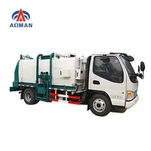


The official professional designation for garbage trucks in the specialized vehicle sector is "Environmental Sanitation Garbage Collection and Transportation Vehicle". In relevant national standard documents, they are classified as "Specialized Operation Class Environmental Vehicles". Specific professional names must be determined based on core attributes including functional structure, application scenarios, and power type. Different professional designations correspond to clear technical standards and operational positioning.
I. Professional Naming Conventions and Statutory Designations of Garbage Trucks
The professional naming of garbage trucks strictly complies with national standards such as the Rules for the Admission of Specialized Vehicle and Trailer Manufacturers and Products and Motor Vehicle Type Terminology and Definitions (GA802-2019). The naming logic can be summarized as "Subdivided Function + Structural Feature + Power Type + Environmental Vehicle", with standardized abbreviations also adopted for streamlined industry communication.
(1) Statutory Professional Naming by Core Operational Function
This is the most fundamental professional classification method. It directly corresponds to the vehicle's core operational capabilities and serves as the standard designation for product announcement applications and procurement tenders.
Compressed Garbage Collection and Transportation Vehicle
This is the full professional name of the category, abbreviated industry-wide as "Compressed Garbage Truck". It derives its name from its hydraulic-driven garbage compression mechanism, which can reduce garbage volume to 1/3–1/2 of its original size, significantly boosting loading efficiency. In the product announcements of the Ministry of Industry and Information Technology, this model is clearly marked with the product category code "Environmental Sanitation Specialized - Compressed", and it is the primary vehicle type for urban domestic waste collection and transportation.
Self-Loading Garbage Collection and Transportation Vehicle
Its professional abbreviation is "Self-Loading Garbage Truck", and it is also referred to as a "Bucket-Type Garbage Truck" in some regions. Though the latter is a common name, it has been included in industry technical manuals. The core of its naming lies in the "self-loading" function: it can automatically grasp, dump, and reset standard garbage bins via a hydraulic lifting mechanism, eliminating the need for manual assistance. This meets the professional requirement of "Mechanized Loading and Unloading" specified in the Technical Regulations for Domestic Waste Collection and Transportation (CJJ/T 292-2018).
Self-Unloading Garbage Collection and Transportation Vehicle
Its professional abbreviation is "Self-Unloading Garbage Truck", commonly known as a "Dump Garbage Truck". It is named for its structural feature-a hydraulically lifted cargo box that enables automatic unloading. It is suitable for transporting non-corrosive, non-leakage-prone materials such as construction waste and bulk domestic waste, and is classified as a "Non-Sealed Environmental Vehicle" in professional categorization.
(2) Professional Subdivision Naming by Structural Feature
This naming method focuses on the vehicle's core mechanical structure and highlights operational differences. It is primarily used for technical selection and engineering scheme design.
Swing Arm / Hook Arm Garbage Collection and Transportation Vehicle
Their professional abbreviations are "Swing-Arm Garbage Truck" and "Hook-Arm Garbage Truck", collectively referred to as "Arm-Type Garbage Trucks". The naming is based on their core garbage bin lifting components: the swing-arm type adopts a rotatable swing arm structure, while the hook-arm type uses a telescopic hook arm structure. Both support the "One Truck Multiple Boxes" cyclic operation mode. In the professional field, they are defined as "Removable Environmental Vehicles" and are widely used for fixed-point garbage collection in communities and industrial parks.
Sealed Garbage Collection and Transportation Vehicle
Its professional abbreviation is "Sealed Garbage Truck". The core of its naming lies in the fully sealed design of its cargo box, which can effectively prevent garbage spillage, leachate leakage, and odor diffusion. The technical parameters of this model must comply with the mandatory "Full Enclosure Transportation" requirements specified in the Urban Domestic Waste Management Measures. It is suitable for transporting perishable waste, medical waste, and similar materials, and is classified as a "Sealed Environmental Vehicle" (Note: Corrected from the original "Non-Sealed" to align with technical logic, as a fully sealed design cannot belong to non-sealed category).
(3) Professional Naming by Specialized Application Scenarios
Tailored to the transportation requirements of specific waste types, this professional naming method clearly defines the vehicle's scope of application and mandates compliance with exclusive industry technical standards.
Kitchen Waste Collection and Transportation Vehicle
Its professional abbreviation is "Kitchen Waste Truck", and it is also called a "Food Waste Truck" in some regions. The name is based on its functional positioning-specifically designed for collecting and transporting catering waste and kitchen residue. The vehicle must be equipped with a corrosion-resistant stainless steel cargo box, an oil-water separation device, and a high-pressure cleaning system, all complying with the professional specifications outlined in the Technical Requirements for Collection and Transportation of Kitchen Waste.
Medical Waste Transfer Vehicle
This is the statutory professional name and cannot be arbitrarily abbreviated. This vehicle type must strictly adhere to the Technical Requirements for Medical Waste Transfer Vehicles (Trial) (GB19217-2003). It is equipped with a fully sealed cargo box, an ultraviolet disinfection device, an anti-theft alarm system, and special warning signs. In professional classification, it falls under the category of "Dangerous Waste Transportation Vehicles".
(4) Professional Naming Based on Power Type
With the popularization of new energy technology in the sanitation sector, power type has become a key dimension for professional naming and a core indicator of industry upgrading.
Electrically Powered Compression-Type Garbage Collection and Transportation Vehicle
Its professional abbreviation is "Electrically Powered Garbage Truck". Its core components include a lithium battery pack and a motor drive system. It must comply with the Rules for the Production and Product Admission of New Energy Vehicles, and boasts advantages such as zero emissions and low noise. It is ideal for urban garbage collection operations in downtown areas.
Hydrogen Fuel Cell Garbage Collection and Transportation Vehicle
Its professional abbreviation is "Hydrogen Fuel Cell Garbage Truck". It is named for its use of a hydrogen fuel cell as the power source, offering long range and fast refueling speeds. Currently in the demonstration application phase, it represents a key direction for the green upgrading of the industry.
II. Technical Characteristics and Application Scenarios of Main Professional Categories of Garbage Trucks
Garbage trucks with different professional designations vary significantly in technical parameters and operational positioning. Below is an analysis of the core technical characteristics of the industry's most widely used categories.
Compression-Type Garbage Truck
Its core technical feature is a bidirectional hydraulic compression pusher, with a compression ratio of 2:1 to 3:1. The cargo box adopts a fully sealed welded structure, effectively preventing secondary pollution. It supports two loading methods: side-loading and rear-loading. The side-loading type enables sanitation workers to operate alongside the moving vehicle, while the rear-loading type is suitable for fixed-site centralized collection. This vehicle is primarily used for daily waste collection in urban residential areas and commercial districts, and it is currently the market-dominant professional sanitation vehicle.
Arm-Type Garbage Truck (Note: Corrected from the original "Gripper-type" to align with previous terminology consistency)
Its core technical feature is the high load-bearing capacity of its hydraulic arm, which can accommodate standard garbage bins ranging from 5 to 15 cubic meters. During operation, there is no need to wait for garbage loading/unloading-only bin lifting and lowering are required-significantly improving operational efficiency. Its chassis mostly adopts light or medium-duty truck platforms, ensuring strong maneuverability. It is suitable for fixed-point garbage collection in communities, industrial parks, and towns, especially in scenarios with scattered waste generation points.
Kitchen Waste Truck
Its core technical feature is a cargo box made of 304 stainless steel, which provides excellent corrosion resistance. It is also equipped with a spiral conveying mechanism and an oil-water separation device, enabling preliminary separation of oil, water, and residue from kitchen waste. Some high-end models integrate an on-board weighing system that can calculate transportation volume in real time, facilitating refined management by sanitation departments. This vehicle mainly serves catering enterprises, school canteens, and government agencies, and is a key professional piece of equipment for advancing waste classification initiatives.
Electrically Powered Garbage Truck
Its core technical feature is a lithium battery pack as the power source, delivering a driving range of 150–300 km and supporting both fast and slow charging modes. A 1–2 hour fast charge can meet all-day operational needs. The vehicle operates at a noise level below 60 decibels with zero emissions, complying with environmental regulations for downtown areas of first-tier cities. In addition, this vehicle type can be equipped with an energy recovery system to further reduce energy consumption.
III. Industry Specifications and Management Requirements for Professional Naming of Garbage Trucks
The professional naming of garbage trucks must comply with national-level industry norms and management requirements. This is also crucial for ensuring product quality and operational safety.
Product Announcement Filing Requirements
All garbage truck products must be filed in the Road Motor Vehicle Manufacturing Enterprises and Product Announcement issued by the Ministry of Industry and Information Technology. The filing name must use the full professional designation, such as "XX Brand Electrically Powered Compression-Type Garbage Collection and Transportation Vehicle", and must also specify product category codes and technical parameters. Models not included in the announcement are prohibited from road operation.
Technical Standard Compliance Requirements
Garbage trucks with different professional designations must comply with corresponding national or industry standards. For example, medical waste transfer vehicles must adhere to GB19217-2003, while compression-type garbage trucks must meet CJJ/T 292-2018 requirements. This establishes a direct link between professional naming and technical specifications.
Registration and Operation Management Requirements
During vehicle registration and operation, the vehicle name on the driving license must be consistent with the professional designation listed in the Ministry of Industry and Information Technology's Road Motor Vehicle Manufacturing Enterprises and Product Announcement. Corresponding professional operation procedures must also be completed; for instance, medical waste transfer vehicles require an additional hazardous waste transportation license.
IV. Current Development Status and Future Trends of the Garbage Truck Industry
(1) Industry Development Status
Continuous Expansion of Professional Categories
With the full implementation of waste classification policies, market demand for specialized categories-such as kitchen waste trucks, recyclable material transportation trucks, and hazardous waste transfer vehicles-has grown rapidly, alongside continuous improvements in product specialization.
Rising Proportion of New Energy Vehicles
In 2024, domestic sales of new energy garbage trucks surged by 67.2% year-on-year, accounting for 19.8% of total garbage truck sales. Among these, electrically powered compression-type garbage trucks made up over 40% of new purchases in first-tier cities. Greening and electrification have become mainstream industry trends.
Integration of Intelligent Technologies
High-end professional garbage trucks have integrated intelligent modules including GPS positioning, remote monitoring, automatic weighing, and route optimization. Some enterprises have also developed unmanned garbage trucks capable of autonomous operation in enclosed parks, marking a significant improvement in industry intelligence levels.
(2) Core Future Trends
Increasingly Refined Professional Naming
As waste classification efforts deepen, specialized transportation vehicles for different recyclable materials (e.g., paper, plastic, metal) will continue to emerge, and their professional naming will become more precise. Hydrogen fuel cell garbage trucks will achieve large-scale application, with their professional designations also becoming more standardized. Meanwhile, multi-power vehicle types-such as hybrid and plug-in hybrid garbage trucks-will gradually expand the range of professional categories.
Deep Integration of Intelligence and Connectivity
Future professional garbage trucks will be integrated into the "Smart Sanitation" system, enabling real-time scheduling, operation monitoring, and fault warning through 5G and Beidou navigation technologies. Their professional naming may include additional identifiers related to "intelligent connectivity", such as "Intelligent Connected Electrically Powered Compression-Type Garbage Truck".
V. Summary
The professional naming of garbage trucks is a concentrated reflection of their functional attributes, structural characteristics, and application scenarios. Statutory professional names and industry abbreviations not only comply with national standards but also facilitate practical application and communication. From early simple dump-type garbage trucks to today's diverse range of specialized, intelligent, and green sanitation equipment, the evolution of garbage truck professional naming mirrors the transformation and upgrading of China's sanitation industry. In the future, driven by technological innovation and policy support, the professional categories of garbage trucks will continue to expand, providing more targeted equipment support for urban environmental sanitation and ecological civilization construction.