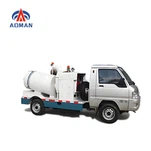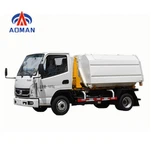


Modern washing and sweeping vehicles have long transcended their basic mechanical functions. Through the deep integration of mechatronics, sensor technology, the Internet of Things (IoT), and new energy technologies, they are rapidly evolving towards high intelligence and green environmental protection. The application of these cutting-edge technologies has significantly enhanced their operational efficiency, quality, and management capabilities.
In terms of intelligence, the first aspect is "Intelligent Operation Control." Vehicles can be pre-set with various operation modes, such as "Eco Mode," "Intensive Sweeping Mode," and "Rainy Day Mode." The system automatically adjusts water pump pressure, brush rotation speed, and fan power to adapt to different road conditions. Next is "Intelligent Obstacle Avoidance and Arm Adjustment." Using ultrasonic or pressure sensors mounted on the sweeping disks, the system can perceive in real-time the distance and collision risk between the disks and obstacles like curbs, parked cars, or cones. Upon encountering an obstacle, the sweeping disk automatically lifts or retracts, and resets itself afterward, greatly reducing component damage and manual intervention. Furthermore, there is "Route Planning and Remote Monitoring." Via GPS and IoT modules, real-time data such as the vehicle's location, operational status, fuel/electricity consumption, and tank capacity are transmitted to a cloud-based management platform. Managers can monitor the entire fleet from computers or mobile phones, enabling intelligent task dispatch, optimized cleaning routes, and digital assessment of operational effectiveness.
Regarding environmental protection, the most notable innovation is the "New Energy Power System." Traditional washing and sweeping vehicles use diesel auxiliary engines, which are noisy and have high emissions. Nowadays, zero-emission chassis powered by pure electricity or hydrogen, along with electrically driven auxiliary systems, are becoming the trend. They achieve "zero emissions" and low noise during operation, making them particularly suitable for urban centers and night operation zones with strict air quality and noise control requirements. The second key area is the "High-Efficiency Water Recycling System." To address water scarcity, advanced washing and sweeping vehicles are equipped with three-stage or even four-stage water treatment systems, including sedimentation, hydro-cyclonic separation, fine filtration, and chemical/physical purification. The treated grey water can meet reuse standards for road flushing, reducing the vehicle's overall clean water consumption by over 70% and enabling sustainable operation with "less water or no external water supply." Additionally, "Low-Noise Fan and Pump Unit Design" also reflects the environmental protection concept, minimizing disturbance to the urban sound environment.
The integration of these intelligent and environmentally friendly technologies has not only transformed the washing and sweeping vehicle into a mobile "intelligent environmental protection workstation" but has also propelled the entire sanitation industry towards a strategic transformation from labor-intensive to technology-intensive, and from high-carbon to green and low-carbon operations.