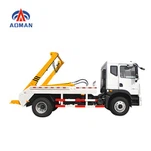


In the commercial vehicle sector, while truck classification systems vary by country due to differing regulatory frameworks and transportation needs, the standard centered on Gross Vehicle Weight Rating (GVWR) has emerged as an internationally recognized technical specification thanks to its cross-regional applicability. The three core categories-light-duty, medium-duty, and heavy-duty trucks-feature distinct technical boundaries defined by their vastly different payload capacities and functional positioning. These categories are widely integrated into key fields such as logistics operations, industry management, and vehicle R&D across mature markets including North America and Europe.Drawing on industry norms and application practices in European and American markets, this paper provides a detailed analysis of the core characteristics of these three truck types.
I. Light-duty Trucks: The Core Carrier for Urban Short-distance Transportation
Light-duty trucks are the primary vehicle type for urban logistics and short-distance distribution in overseas markets. Their core definition revolves around low load capacity and high maneuverability. While GVWR standards vary slightly by market, the overall range remains highly consistent.
In the North American market, standards set by the U.S. Federal Highway Administration (FHWA) classify light-duty trucks into two categories: Class 1 (0–6,000 pounds) and Class 2 (6,001–10,000 pounds). Class 1 vehicles are mainly compact pickup trucks, such as the Ford Ranger and Toyota Tacoma; Class 2 includes midsize and full-size pickup trucks (e.g., the Ford F-250 and Chevrolet Silverado 2500) as well as small cargo vans. In the European market, light-duty trucks are typically defined with an upper gross weight limit of 3.5 tons. Common models include small delivery vans and pickup trucks, whose compact design makes them particularly suitable for meeting the dimensional and turning radius requirements of urban roads.
In terms of application scenarios, light-duty trucks play a crucial role in the logistics sector, being widely used for "last-mile" delivery. This includes parcel delivery for e-commerce platforms (e.g., Amazon), fresh produce replenishment for supermarkets, and small-scale moving services. Their core advantages are threefold: first, excellent operational maneuverability, allowing them to navigate narrow streets and parking lots with ease; second, a relatively low driving threshold-most markets do not require a Commercial Driver's License (CDL), which significantly reduces operational costs; third, they conform to the global shift toward new energy, making electric light-duty trucks a new favorite in overseas markets. For example, electric pickup trucks like the Tesla Cybertruck and Rivian R1T are accelerating their penetration into urban delivery scenarios thanks to their zero-emission feature.
II. Medium-duty Trucks: The Linking Hub for Regional Transportation
Medium-duty trucks serve as the key vehicle type bridging urban short-distance distribution and long-haul trunk transportation. With load capacity and range falling between light-duty and heavy-duty trucks, they are well-suited for medium-and short-distance intercity transportation needs. International classification standards for medium-duty trucks are relatively unified, with their core positioning defined as regional distribution and specialized services.
In the European market, medium-duty trucks are defined by a gross weight range of 3.5 to 12 tons.
Application Scenarios
In the logistics network framework, medium-duty trucks, with their unique payload capacity and scenario adaptability, serve as a key link in urban logistics systems. Their core functions focus on three primary areas: intra-city medium-and-short-distance transportation of industrial raw materials, bulk food delivery for the catering industry, and high-frequency, small-batch regional logistics operations.
Compared with light-duty trucks, medium-duty trucks offer distinct advantages in transportation capacity: their payload can be 40%–60% higher, and they support modular customization to be converted into specialized transport vehicles. Equipped with temperature control systems, they can function as refrigerated trucks, ideal for fresh food delivery; modified into sanitation vehicles, they can meet the needs of urban waste collection. This versatility makes them the "Swiss Army knife" of urban logistics.
Compared with heavy-duty trucks, medium-duty trucks have three key operational cost advantages: first, fuel consumption is reduced by approximately 25%, significantly lowering transportation costs; second, their axle load is better aligned with urban road design standards, effectively minimizing road wear; third, they can be loaded and unloaded using onboard or simple equipment, reducing reliance on specialized loading terminals. These attributes make medium-duty trucks an ideal choice for balancing transportation efficiency and infrastructure protection.
Regulatory Framework
In terms of driver qualification management, different markets implement differentiated entry requirements for medium-duty truck drivers: in certain regions, the entry threshold for medium-duty trucks is higher (requiring additional training or certification) but still lower than the stringent regulatory standards for heavy-duty trucks. This tiered regulatory framework effectively achieves a dynamic balance between optimizing transportation efficiency and ensuring road safety through risk-based oversight.
III. Heavy-duty trucks serve as the backbone of cross-border logistics systems.
With their high payload capacity (generally exceeding 20 tons), extended driving range (up to 1,500 kilometers or more on a single tank of fuel), and superior power performance, they have become the preferred solution for international bulk cargo transportation. Their technical standards are closely integrated with road regulations, driver qualification certification systems, and environmental protection policies, making them the focal point of technological competition in the global commercial vehicle sector.
Regional Market Classification Systems
North American Market
The classification standard for heavy-duty trucks covers Class 7 and Class 8:
Class 7: Gross Vehicle Weight Rating (GVWR) ranging from 19,501 to 26,000 pounds (8.845 to 11.793 tons)
Class 8: GVWR exceeding 26,000 pounds (11.793 tons)
Typical models include the Kenworth T680 and Freightliner Cascadia. Note: The Freightliner M2, mentioned in previous content, is a medium-duty truck; the Cascadia is selected here to comply with heavy-duty classification standards. Most of these vehicles are coupled with 48-foot (14.6 meters) or 53-foot (16.2 meters) trailers, including dry vans, flatbeds, and refrigerated trailers. Boasting a maximum payload of 45,000 pounds (20.4 tons) and a cargo volume of 4,000 cubic feet, they can efficiently handle cross-regional transportation of bulk goods such as coal and heavy machinery.
European Market
The gross weight threshold for heavy-duty trucks is set at 12 tons. These trucks mainly adopt semi-trailer or full-trailer configurations, forming the backbone of the EU cross-border logistics network.
Global Regulatory Framework
The international regulatory system is showing a distinct trend of convergence, with the following core requirements:
Driver Qualification Requirements: Mandatory implementation of the Commercial Driver's License (CDL) certification system.
Environmental Standards: Compliance with U.S. EPA emission regulations and EU Euro VI standards is required.
Technical Development Pathways: Driven by regulatory policies, powertrain systems are accelerating their evolution toward high-efficiency diesel, natural gas, and pure electric technologies.
Infrastructure Dependency
The operational efficiency of heavy-duty trucks is strongly correlated with supporting infrastructure:
Key Nodes: Highway rest areas, specialized loading and unloading terminals, and heavy-duty maintenance centers constitute the three core supporting elements.
Technical Linkage: The level of vehicle intelligence is positively correlated with the modernization level of local logistics infrastructure.
Competitiveness Indicators: The adoption rate of new energy technologies and the penetration rate of autonomous driving systems have become core metrics for evaluating regional logistics competitiveness.